Pathway to Practice: How North Dakota Keeps Its Physicians Rural
By Stacy Kusler on
The success of rural healthcare starts with a critical factor: having the healthcare workforce in place to provide it. In their "outsized" roles, these trusted rural teams provide care at home and, when needed, get patients to additional services in urban centers.
But how does rural North Dakota find its healthcare providers – its doctors in particular? Perhaps the bigger question is how does it keep them?
The state's workforce experts know that finding and keeping physicians – referred to as "recruitment and retention" – is a process that must begin long before a practice contract is signed. The current collaborative efforts of the state's only medical school, several state government agencies, and the rural communities themselves involve several key elements: reaching students early to inspire healthcare careers, providing meaningful rural training experiences during medical school, and offering financial or service-based incentives that make practicing in rural communities more attractive.
Healthcare Career Beginnings
During the 2025 legislative session, state lawmakers tasked the University of North Dakota School of Medicine & Health Sciences (UND SMHS) leadership with a specific goal: 85% of students in the MD and Physician Assistant (PA) programs should be North Dakotans.
ND85, as the enrollment goal is now known, launched with a clear focus of reaching students in middle school, high school, and early postsecondary years to build awareness, confidence, and readiness for a future medical career, preferably in North Dakota.
Emily Evers, UND SMHS assistant director of admissions and recruiting and the public face of the ND85 outreach, is already at work.
When I go speak to high schoolers, the message I want to convey is simple: you can do it.
"When I go speak to high schoolers, the message I want to convey is simple: you can do it," Evers said. "Students are very focused on the present, and maybe not so much on what happens after high school, so communicating that their choices can have a massive impact on their future is important. My hope is that they recognize that UND has the only medical school in the state, and getting there is possible."
In addition to Evers' work, a key part of ND85 is connecting with existing programs that already work to introduce students to healthcare careers. These include Scrubs Camps and Academies offered to middle and high school students through the UND Center for Rural Health, as well as the student-led organization, HOSA Future Health Professionals, that now includes more than 1,000 North Dakota high school and college students exploring health career pathways.
Dr. Marjorie Jenkins, UND SMHS dean, said ND85 is a reflection of her philosophy that North Dakota's youth should have early and sustained exposure to healthcare careers, allowing them to realize that a healthcare career is realistic and attainable, and the state's only medical school is the institution that can offer them a premier education.
"This initiative will serve North Dakota by strengthening the pathway of students who are motivated to practice in rural communities and meet the healthcare needs in our state," she said. "Improved rural recruitment and retention serve the entire state and keep North Dakotans at the center of our work every day."
Train in Rural, Remain in Rural
Backed by national research that training students and physicians in rural areas keeps them in rural areas, Dr. David Schmitz, chair of the School's Department of Family & Community Medicine, a national and state-level rural workforce expert, says, "Training in rural places...sticks!"
Several North Dakota program results prove that this logic holds true. First is ROME, or Rural Opportunities in Medical Education, a 24-week program for medical students. With ROME, students don't just learn at the side of rural community providers – they also experience rural living in Devils Lake, Dickinson, Grafton, Hettinger, and Jamestown, along with the Minnesota communities of Benson and Ortonville.
But medical students graduate and head to several more years of post-medical school training in residency programs. Research shows that at this point in their career, if they train in rural areas, they are much more likely stay rural – regardless if they are from a rural or urban area. To that end, North Dakota has three residency programs that provide training designed to encourage physicians to stay in rural North Dakota.
The first two programs, known as Rural Training Programs, are offered through the Minot and Bismarck family medicine residencies. Partnering with the communities of Williston and Hettinger, residents in Minot and Bismarck begin their training on these two urban campuses before transitioning to the rural hospitals for their second and third years.
The third program is the UND rural surgery track, the designation for rural-specific training within the UND General Surgery Residency program. Dr. Stefan Johnson, program director, emphasizes the essential rural skills of the specialty.
"Rural general surgeons have been described as the lynchpin in the delivery of comprehensive rural healthcare," he said. In addition to general surgical procedures like removing an appendix or taking out a gallbladder, surgeons also provide other procedures like colonoscopies for colon cancer screenings and trauma care for injuries caused by sports, vehicle, farm, or ranch injuries.
Leaders in these programs shared their positive results: ROME has kept nearly 60 of its former participants in North Dakota for practice, while 70% of UND rural surgery track graduates practice in rural areas – a higher percentage than other similar U.S. programs. To date, 15 rural surgery track graduates practice in North Dakota.
Also Making Rural Practice Possible: Financial Investments
While UND SMHS ranks as a top U.S. program for affordability, total in-state resident medical school tuition still hovers around $235,000. However, several options are available for physicians interested in managing those expenses by practicing in rural North Dakota.
One option is through loan repayment programs, administered by the North Dakota Primary Care Office (PCO), which is part of the state's health department, North Dakota Health and Human Services. These programs offer anywhere from $50,000 to $100,000 of loan payment in exchange for two to five years of service in a rural North Dakota community. Another program – created by the 2010 state legislature and known as the RuralMed program – "forgives" medical school tuition if the participant provides five years of rural practice following residency training.
Again, results show these programs work. Over the past 15 years, RuralMed has realized 50 participants. Dr. Josalynne Hoff Rue is one of them.
A 2016 graduate of UND SMHS, Hoff Rue said that RuralMed was central to shaping her family medicine career path. A relatively new program when she entered medical school in 2012, the program offered a dollar amount tied to years of education and Hoff Rue decided to participate in order to begin practicing medicine without the weight of student loans.
The ability to avoid a high debt load early on is what allowed family medicine to make financial sense.
"The ability to avoid a high debt load early on is what allowed family medicine to make financial sense," she said, noting that the decision also aligned with both her professional and personal goals, including raising her family in a rural community. Also, her spouse, a pharmacist, works in the same health system, further strengthening the local workforce.
Following residency at the Bismarck Family Medicine Residency Program, Hoff Rue began her five-year RuralMed commitment at Heart of America Medical Center (HAMC) in Rugby. Seven years later, she's still there. And there not only as a physician, but serving as community faculty for UND SMHS by continuing the mentorship cycle that influenced her own career.
"Although I had great urban mentors in medical school and residency, those in rural areas really invested in my training," she said. "They gave it their all and made such a difference in my life and career. Now, I want to be that person for current students."
Not Just Local Care, But Local Quality Care
The results are irrefutable. Rural residents benefit from local care provided by the RuralMed alums practicing in their towns. However, healthcare administrators like HAMC's CEO Erik Christenson note something else about that care: its quality.
"The [RuralMed] program allows us to recruit physicians trained at the highest level of clinical expertise, like Dr. Hoff Rue, who is at the top of her field," Christenson said, acknowledging that RuralMed was an integral part of bringing Hoff Rue to Rugby. "She's also dedicated to our community and willing to lead our medical staff to their highest level."
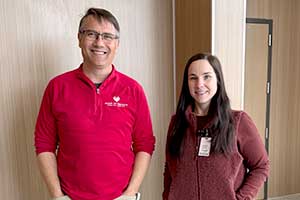
As an aside, Christenson said he's been able to use other loan repayment programs to recruit nurses, nurse practitioners, physician assistants, and other healthcare providers also strategic for rural healthcare. State programs like "Career Builders" and North Dakota Department of Commerce workforce development grants provide similar incentive structures for a range of healthcare professions, ensuring that rural communities have access not only to physicians but to the full interdisciplinary teams required to sustain care delivery.
A Faster Track to Rural Practice
Those involved with North Dakota's recruitment and retention programs recognize that there's a never-ending need for innovation, and a recent philanthropic gift through the Joe and Norma Peltier endowment supports that innovation.
The Primary Care Accelerated Track (PCAT), a new program slated to launch in 2028, reduces time and decreases debt for select students choosing a primary care career. Medical school is completed in three rather than the traditional four years, followed by training in a North Dakota residency program, and a five-year service commitment to rural North Dakota.
Back in Grand Forks, Schmitz highlighted the broader importance of this investment in shaping the future workforce by clarifying the advantages of primary care.
"Family physicians meet patients' most immediate needs, from delivering babies to responding to trauma, making them essential to rural healthcare," he said. "The Peltiers' generosity is helping us 'train our own and grow at home,' a key element in building North Dakota's healthcare workforce."
Taken together, North Dakota's recruitment and retention efforts reflect a clear theme: rural workforce stability is built over time through coordinated strategies and strong partnerships and innovation. With the resulting alignment of education, medical training, financial support, and state legislative efforts, high-quality rural healthcare delivered by clinicians committed to staying rural benefits all of North Dakota.
 is the connection between rural healthcare facilities in North Dakota and qualified health professional job seekers. As the workforce specialist, she assists rural facilities to attract medical providers and other health professionals to their communities by sharing job opportunities. Through her position, Stacy is working to reduce the healthcare workforce shortages throughout the state.


