

The Invisible Injury
By Jessica Rosencrans on
When people think about brain injuries, they often picture life-changing events like strokes or serious car crashes. But some of the most common brain injuries – concussions – are frequently overlooked because they are perceived as less severe.
To combat this misconception, the North Dakota Brain Injury Network (NDBIN) is educating North Dakotans about concussion prevention, recognition, and recovery. NDBIN is housed at the Center for Rural Health (CRH), within the University of North Dakota School of Medicine & Health Sciences.
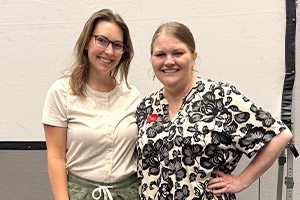
Endres presented on concussion
prevention at the 2026 Dakota
Conference on Rural Health.
One of NDBIN's key messages is that a concussion is a brain injury, not simply a bump on the head.
"Concussions and other brain injuries are often stigmatized because they are invisible injuries," said Carly Endres*, senior project coordinator at NDBIN. "Symptoms sometimes don't show themselves until days or weeks later, but concussions can lead to lifelong effects."
Safety on Wheels
One example of how NDBIN works to prevent concussions is by educating children before an injury occurs. NDBIN collaborates with North Dakota offices of Safe Kids Worldwide, a global network dedicated to preventing unintentional childhood injuries. One of Safe Kids' areas of focus is sports and wheeled sports safety, teaching children how to stay safe as they participate in athletic activities that can result in a concussion.
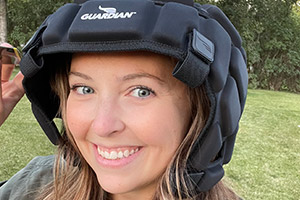 Safe Kids and NDBIN partner to
visit third-grade classrooms and explain the importance
of wearing a helmet when riding a bike or engaging in
other wheeled sports. This Safety on Wheels presentation
is targeted at third-grade students because that is the
age when children often begin riding bikes unsupervised
and are independent enough to ride bikes to school.
Safe Kids and NDBIN partner to
visit third-grade classrooms and explain the importance
of wearing a helmet when riding a bike or engaging in
other wheeled sports. This Safety on Wheels presentation
is targeted at third-grade students because that is the
age when children often begin riding bikes unsupervised
and are independent enough to ride bikes to school.
After the presentation, Safe Kids offers helmet sales to the entire school to ensure that any child in need of a helmet can get properly fitting gear.
Support After Injury
Andrea Watkins, resource facilitator with NDBIN, works with concussions in a different capacity. She receives referrals from across North Dakota for people who have experienced – or suspect they may have experienced – a concussion or another type of brain injury.
"A lot of the work I do with concussions involves school or sports-related referrals," Andrea shared. "Brain injuries can happen in sports where people don't expect them, especially those with limited or no protective equipment."
After receiving a referral, NDBIN resource facilitators work with the individual to screen them for brain injury, help them manage their symptoms, or connect with medical professionals.
But concussion can result in symptoms like headaches, light sensitivity, and trouble tolerating a full day at work or school.
"When you get a concussion diagnosis, you aren't admitted to the hospital, so the perception is that it's not a big deal," said Watkins. "But concussion can result in symptoms like headaches, light sensitivity, and trouble tolerating a full day at work or school."
Endres points out that in the Midwest, people are often reluctant to ask for help. Rural and farming families can also have expectations of their kids to do chores right when they get home from school, regardless of how they are feeling.
Watkins agrees. "A lot of the work I do is with parents, helping them understand that the 'push through it' mentality isn't the best approach after a brain injury, especially during the critical period of recovery. Kids really do need a break when they get home from school."
The Hidden Effects of Concussion
Pushing through the pain can do much more harm than people realize. Returning to sports while the brain is still healing from a concussion can increase the likelihood of experiencing another brain injury.
Watkins encourages people to think of brain injuries as cumulative. While many people recover fully from a single concussion, repeated concussions can build over time, producing effects similar to those of a more severe brain injury.
Brain injury survivors may also face mental health challenges, including depression and thoughts of suicide. Ongoing symptoms and changes in daily life can contribute to depression, anxiety, and social isolation.
Brain injuries can also affect impulse control, meaning some survivors may be more likely to act on thoughts before fully processing them.
"We emphasize the importance of putting space and time between thought and action," Endres said. "We educate survivors about negative thoughts and what tools and strategies they can use to manage them until they pass."
Concussion Symposium
Each September, NDBIN hosts a Virtual Concussion Symposium on National Concussion Awareness Day – the third Friday of the month. This event was specifically created to educate about concussions and other mild brain injuries.
"The Concussion Symposium is a very accessible event for people who are interested in learning about the topic," Endres said. "We offer CEU credits, and all of the sessions are recorded. That way, if working professionals or interested parties have conflicts during the event, they can still have access to the information and earn CEU credit for attending."
In addition to the Concussion Symposium, NDBIN hosts its annual Mind Matters Conference in March during Brain Injury Awareness Month, focusing on moderate and severe brain injuries.
Building a Culture of Prevention
Our goal is to ensure that people across North Dakota understand the signs of concussion, know when to seek help, and recognize that recovery takes time.
Endres emphasized that concussion awareness isn't about discouraging people from participating in sports or other activities. Instead, she said, it's about making sure they have the knowledge to protect their brains and recover appropriately if an injury occurs.
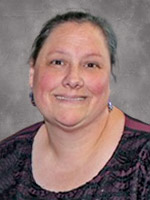
"Every concussion is a brain injury, and every person deserves to have that injury taken seriously," said Rebecca Quinn, associate director of CRH and principal investigator of NDBIN.
"Our goal is to ensure that people across North Dakota understand the signs of concussion, know when to seek help, and recognize that recovery takes time."

Jacob Warren, director of CRH, echoes these sentiments. "Concussions and other brain injuries can affect anyone, regardless of age or where they live, and NDBIN plays a vital role in ensuring North Dakotans have the information and support they need. Their work strengthens individuals, families, schools, and communities across North Dakota," he said.
Although Endres and Watkins agree that concussion education has come a long way in the past few years, it's still a topic that needs to be addressed. The more we talk about concussion and brain injury, the less stigmatized it will be.
And despite the many tools and resources NDBIN provides, the team believes the best way to manage a brain injury is to prevent it from happening in the first place. Even one concussion is too many.
*Carly Endres has left the Center for Rural Health as of August 2026.
 is the communication specialist with the Center for Rural
Health at the University of North Dakota School of
Medicine & Health Sciences in Grand Forks.
is the communication specialist with the Center for Rural
Health at the University of North Dakota School of
Medicine & Health Sciences in Grand Forks.


