
Behavior
Across all ages, behavior is a form of communication. People often express needs, emotions, challenges, or frustrations through their actions when they lack the ability, skills, or resources to communicate them directly or address them independently.
Understanding Behavior
Behavior is not judged as good or bad; instead, it is understood in terms of its function – what purpose does it serve for the individual? Now it is your job to figure out what that purpose is and what they are trying to communicate.
Functions of Behavior
The four main functions of behavior are:
- Escape/avoidance
- Attention or connection seeking
- Access to tangibles
- Sensory stimulation
The ABCs of Behavior
The ABCs of behavior is a model that helps us understand why people behave the way they do and how we can encourage positive behavior change.
A – Antecedent: What happens before the behavior. This is the trigger, cue, or situation that sets the behavior in motion.
B – Behavior: The action or behavior itself.
C – Consequence: What happens after the behavior. Consequences make a behavior more or less likely to happen again.
By looking at antecedents and consequences surrounding the behavior, we can better understand its purpose and create effective person-centered plans to reduce that behavior and replace it with positive strategies.
De-escalation
De-escalation is the process of helping a person who is upset, distressed, or in crisis become calm and regain control of their emotions and behavior. It involves using strategies to prevent a situation from intensifying. De-escalation can be used with people of all ages to promote safety, respect, and positive outcomes.
De-escalation Essentials
|
S
|
A
|
F
|
E
|
|---|---|---|---|
| Space Give space but stay within proximity |
Assure and Validate Acknowledge feelings sincerely |
Few Words Use minimal, clear, simple language |
Easy Choices Offer options, avoid orders |
Stages
Trigger: Something that happens before a behavior that causes distress. Triggers can be situations, events, people, thoughts, feelings, or environmental factors.
Agitation: This stage looks different for everyone. Once you learn the triggers of those you are caring for, it is easier to recognize and quickly diffuse with coping strategies. View a coping skills list.
-
Address and minimize
- Differentiation: Adjusting the path to an expectation based on a person's needs to help them grow
- Offer a break
- Distract
- Sensory resources are used to engage one or more of the body's senses to help regulate the nervous system.
- Avoid a fight or a power struggle
- Redirect back to the task in a different way
Acceleration: During this stage, the person usually becomes hyper-focused on the problem.
- Give space
- Limit verbal language
- Offer coping strategies
Peak: During this stage, the person is out of control, possibly getting aggressive, running, hiding, or unsafe.
- Remove people nearby
- Remove objects that could become harmful
- Provide support for safety if needed
De-escalation: Your only job now is to stay calm and defuse the situation to keep everyone involved safe.
- Do NOT address their negative behavior when they are dysregulated
- Provide space
-
Use neutral body language
- Hand gestures and sudden movements can be seen as a threat
-
Model calm, regulation
- Speak slowly
- Use calm language and tone
-
Empathy and validation
- Use active listening to the person's words and body language
- Make them feel heard
- Use "I statements"
- Broken record language (repeat back what you are hearing/understanding)
- Realistic options
- Offer support, not commands
- Replace demands with choices (offer options that you are okay with them choosing)
- De-escalation Best Practices: Do's and Don'ts
- De-escalation (video)
Recovery and repair: This step is often overlooked and forgotten about once the behavior is de-escalated and emotions are high. This is arguably one of the most important steps in order to see positive behavior change.
- Breathing, grounding, sensory work, and strategies to regain calm and control over their body
-
Move their body
- Walk, sensory pushes, get in nature
- Self-care. Taking care of yourself in these intense situations is just as important to prevent burnout and continue quality care.
- Complete the After Crisis Checklist | Blank
-
Repair the relationship to ensure that trust still co-exists
- Restorative conversations
- Hearing both sides
- Leading with "I felt..."
- Bonding over a preferred activity
-
Come back to learning the lagging skill when they are regulated
- Break the skill into smaller steps
- Model the skill
- Use visual supports
- Role play practice
- Teach during calm moments
- Reinforce success
- Teach replacement behaviors
- After Crisis Care (video)
Behavior Vs. Behavioral Health
Behavior refers to the actions and reactions of a person, what they do in everyday life. Behavioral health is a broader term that focuses on how a person's behaviors affect their mental, emotional, and physical well-being. It includes habits, coping skills, mental health, and lifestyle choices that influence overall health and quality of life.
Employer Tip Sheet
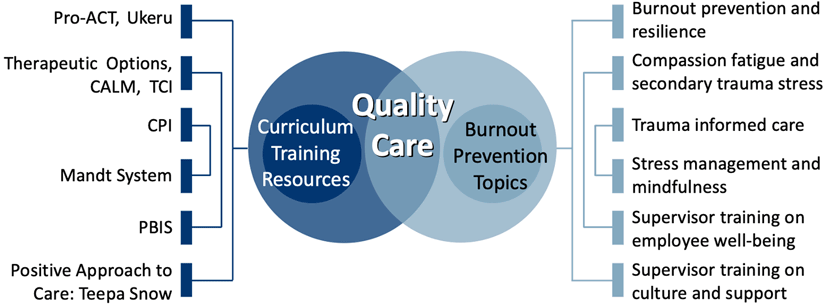
Educating employees with relevant and meaningful training helps staff feel supported, confident, and prepared. When employees are well-equipped, they can provide higher quality care.
Staff Trainings
Below are some possible staff training topics that employers can incorporate into their professional development to support staff and promote employee well-being.
Training Resources
- Pro-ACT training provides workplace violence prevention and de-escalation trainings available online and on-site locations.
- Ukeru training focuses on effective communication with the individuals you serve and how to diffuse stressful, escalating behaviors.
- The CALM model includes person-centered de-escalation techniques, self-care tips, and community resources.
- The Crisis Prevention Institute (CPI) provides trainings to help identify, prevent, and de-escalate crises.
- The Mandt System training can provide you with tools to affirm your feelings and choose your behaviors to keep yourself and others safe during difficult interactions.
- Therapeutic Options aims to reduce violence and the use of restraints and seclusion in behavioral health care.
- Positive Behavioral Interventions & Supports (PBIS) works to prevent unwanted behaviors and develop skills before more serious problem behaviors start.
- Therapeutic Crisis Intervention (TCI) is a trauma-informed crisis prevention and intervention model that assists in preventing crises, de-escalation, managing crisis phases to reduce injuries, and learning ways to handle stressful situations.
- Teepa Snow's Positive Approach to Care includes techniques to grow your relationship with the individual you serve while experiencing less resistance and less stress.