Helping Elders Age in Place
By Jena Pierce on
 Caring for Native Elders is a way to show respect, honor,
and love, and is a long-held tradition for many Native
tribes. Providing caregiving is woven through centuries
of culture and it takes time, patience, and training. And
keeping Elders in their homes for as long as possible is
a priority for many tribes. The Native
Aging in Place Project (NAPP) understands the
history, the willingness, and is ensuring Elders who wish
to age at home are getting the caregiving they deserve.
Caring for Native Elders is a way to show respect, honor,
and love, and is a long-held tradition for many Native
tribes. Providing caregiving is woven through centuries
of culture and it takes time, patience, and training. And
keeping Elders in their homes for as long as possible is
a priority for many tribes. The Native
Aging in Place Project (NAPP) understands the
history, the willingness, and is ensuring Elders who wish
to age at home are getting the caregiving they deserve.
NAPP, housed within the National Resource Center on Native American Aging (NRCNAA), at the Center for Rural Health (CRH), part of the University of North Dakota (UND) School of Medicine & Health Sciences, has been providing services and resources to North Dakota tribes for a decade. It will be able to continue to do so thanks to a new and increased round of funding, $2.5 million, from Margaret A. Cargill Philanthropies.
Since 2009, CRH has provided the Native Elder Caregiver Curriculum (NECC) to be utilized by tribal communities across the nation. The NECC is a caregiver training that trains Native Elder caregivers to care for tribal Elders in their community to help them age in place at home. It was developed in partnership with NRCNAA, the Spirit Lake Elders Advisory Group, the director and staff members of the American Indian Student Services at UND, and the Tribal Community Health Representative Trainer/Tribal Community Health Consultant Dr. Chris Burd. Dr. Burd was providing this training to North Dakota tribal caregivers, including in Spirit Lake Nation. She was also working with the tribe to build home and community-based services (HCBS) for elderly tribal members and those with disabilities. The potential was easy to see. By training skilled providers and caregivers, Elders could remain at home longer and live a fuller life.
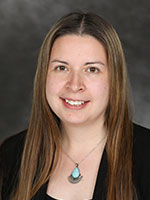
"It was a great opportunity and something that was really needed," said Dr. Collette Adamsen, director of NRCNAA.
"Our Elders want to remain at home and in their communities. NAPP has provided this opportunity by working in partnership with tribes to build and sustain HCBS, so our tribal Elders have access to services that allow them to age in place at home and in their communities."
Our Elders want to remain at home and in their communities.
Adamsen continued, "Without these services, it could lead to our Elders requiring higher level care, which oftentimes means having to go to a nursing home or a long-term care facility that is outside of the tribe. This takes them away from their supportive structure in the community. It can further impact their health negatively, since they are away from home in an unfamiliar place. By making these services available, it allows them to stay connected to their family, culture, and community, which helps to keep our Elders healthy overall."
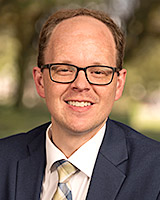
Dr. Jacob Warren, director of CRH, is pleased to see the work not only continue but also expand.
"The Native Aging in Place Program has been a powerful connector between NRCNAA, the Center for Rural Health, and the tribal nations in North Dakota," said Warren. "The training and resources we have been able to share has made a difference in helping Elders age in their homes for as long as possible, while ensuring they receive care needed, especially through our partnership with Spirit Lake Nation."
Building a QSP Agency in Spirit Lake
Over the life of the program, NAPP has worked closely with Spirit Lake Nation to build a Qualified Service Provider (QSP) Agency. At their office, located in Fort Totten, North Dakota, QSPs are trained as caregivers who work with clients who have been admitted into the program through North Dakota's Health and Human Services Aging and Disability Resource Link (ADRL). The caregivers are then able to bill Medicaid for the services, helping grow the local provider workforce, while caring for others.
...a lot of our Elders were going to the nursing home for simple services that could be taking place at home...
Heather Skadsem, Spirit Lake Tribal Health manager, knows the process from the inside out. She spent six years as the long-term services and supports tribal liaison during her time at UND before she moved to her new position. "As a former Title VI director, we were doing our outreach services and realized we needed those services in place because we were finding a lot of our Elders were going to the nursing home for simple services that could be taking place at home, and we could be providing at home."
At their busiest, the agency had seven QSPs and served 30 clients. The work slowed when COVID arrived. Elisha Lawrence Poulsen is the QSP coordinator for Spirit Lake. She shared the challenges of finding workers as the agency plans to grow. "We have one lead QSP and one full-time QSP, but the rest are part-time, and it is hard to keep those workers. It is great if a college student wants part-time work, but often they have to leave. We are increasing our outreach efforts and hope to grow our workforce." The agency is currently serving 17 clients, a mix of Elders, some with disabilities, some vulnerable adults.
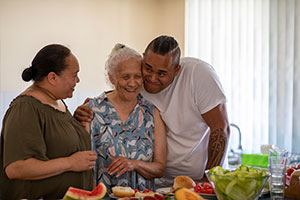 There are a variety of services the clients may qualify
for, including: home care, personal care, non-medical
transportation, non-medical transportation escort (which
means the QSP physically helps them shop in the store),
and private pay medical transportation (out of town). The
most requested help is for homemaker services, which
consists of housework, shopping, laundry, and sometimes
meal prep.
There are a variety of services the clients may qualify
for, including: home care, personal care, non-medical
transportation, non-medical transportation escort (which
means the QSP physically helps them shop in the store),
and private pay medical transportation (out of town). The
most requested help is for homemaker services, which
consists of housework, shopping, laundry, and sometimes
meal prep.
Darlene Myhre is the lead QSP with the agency, and her duties also include outreach, medical transportation, non-medical transportation, and medication pick up for clients. She works with families and individuals to help them navigate the application process through ADRL to get services, along with providing community resources that are available if there are additional needs.
In addition to her other duties, Myhre sees that all their other needs are met, especially nutrition. She picks up food boxes and delivers them to clients in need who depend on access to food, especially if they have no transportation. Meal prep may also fall under this category. If daily care is needed, the staff are able to reach out to local individual QSPs. The agency and individual QSPs work with case managers to ensure the best care for their clients.
Myhre shared the QSPs even do some charting. "We know our clients, we know who they are, how they talk, how they act, how they walk, so when we see decline coming, we will chart that, report that, and when it is time for them to go (to a facility), we talk to them about it, so they know what is happening. It can make the transition easier."
Veteran Support and Resources
 Along
with the HCBS programs, NAPP has also focused on helping
Veterans. The first Stand Down for Native Veterans event
occurred in Spirit Lake, in partnership with Native Eco
Solutions and the Fargo Veterans Affairs (VA) office, in
2023.
Along
with the HCBS programs, NAPP has also focused on helping
Veterans. The first Stand Down for Native Veterans event
occurred in Spirit Lake, in partnership with Native Eco
Solutions and the Fargo Veterans Affairs (VA) office, in
2023.
Dean Dauphinais, founder of Native Eco Solutions, and a former Marine, consults on Veteran-related projects. He partnered with NAPP to bring the Stand Down event format to North Dakota. The one-and-a-half-day event focuses on bringing speakers to share information and education along with a resource fair which brings in people from the VA, and other nonprofits that offer services to Native Veterans. After the first day, a sit-down dinner is held, and often the Veterans will bring their families to hear from keynote and motivational speakers.
"Each event has had more participants than the previous one. We are pleased this is a collaborative event focused on removing the barrier of not knowing, providing help, and improving the quality of life of our Native Veterans and their families that come and experience these events."
The Stand Down has become an annual event and moved across the state. In 2024, it was held with the Turtle Mountain Band of Chippewa, and in 2025, it was held with the Three Affiliated Tribes, also known as MHA Nation. In 2026 the event will be held with the Standing Rock Sioux Tribe.
This was a good opportunity to bring VA representatives to tribal communities and meet them where they are at.
"This was a good opportunity to bring VA representatives to tribal communities and meet them where they are at," said Adamsen, "We have had some really successful stories about people who gave up, couldn't navigate the complicated system, especially the Elder Veterans, and ended up getting signed up for benefits and getting the services they earned many years ago. It is a good feeling to hear those stories."
Relationships & Sustainability
NAPP works with the other tribes in North Dakota too. "We provide support and technical assistance," said Adamsen, "if they have questions or want to start building their HCBS capacity or start their own QSP agency, we can work in partnership to assist their community. We can answer questions, point them in the right direction, assist them with connecting to resources, training opportunities like NECC, and other beneficial trainings that are available. It allows us to build a strong network of support to help each other."
This new round of funding is also offering an additional opportunity. Later this year, NAPP will open a request for proposal to fund another tribe. Tribes in North Dakota, Minnesota, South Dakota, Wisconsin, and Alaska will be eligible to apply. "The tribe selected for the award will receive funding for two years, and we will work in partnership with the community to build a sustainable HCBS model that will expand access to services for tribal Elders in their community, allowing them to age in place at home," Adamsen explained.
NAPP received the first round of funding in 2016, for three years, and since then, they have continued to be funded at increasing levels each round. "The first grant round was focused on partnering with Spirit Lake Nation and working in partnership to build their agency," said Adamsen. "Then the program grew into branching out to other North Dakota tribes and the workforce development piece, through providing technical assistance to independent QSPs. We have been able to help walk them through the billing, getting them set up, and other questions they have about the process. With the new grant, we are excited to be given the opportunity to expand our reach and help a new tribe set up their HCBS program to provide access to these services for their Elders."
Helping Native Elders remain in their homes longer and allowing them to age in place helps keep them involved in their community, sharing cultures and traditions with loved ones, and bring dignity to aging. And the Elders and their families are thankful for the QSPs that make this happen.
 is the communications manager at the Center for Rural
Health at the University of North Dakota School of
Medicine & Health Sciences in Grand Forks.
is the communications manager at the Center for Rural
Health at the University of North Dakota School of
Medicine & Health Sciences in Grand Forks.


